
 English
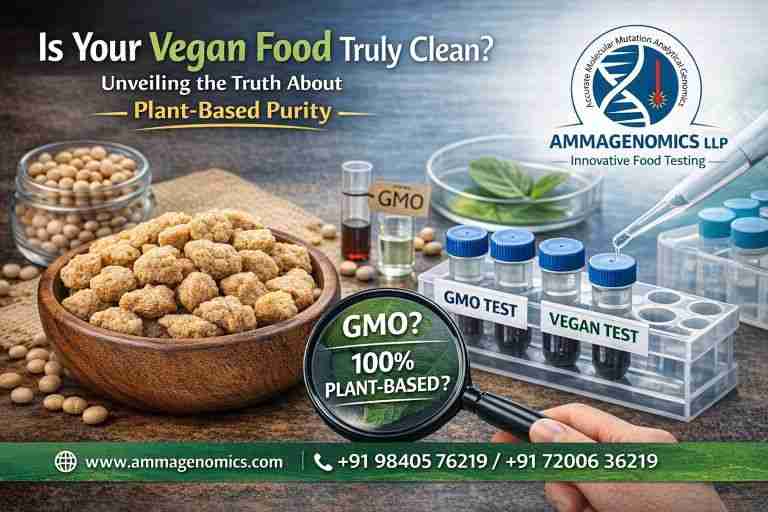
Is Your Vegan Food Truly Clean? Understanding Plant-Based Purity & Verification
A few weeks ago, a mother walked into our laboratory with a thoughtful question.
Her young son had been consuming soy chunks regularly. They were promoted as a healthy plant-based protein, ideal for growing children. Over time, however, she noticed persistent gas formation, bloating, and signs of gut discomfort.
She did not ask whether soy was “good” or “bad.” She asked something deeper: “Is the vegan food my child is eating truly pure? Is it genuinely plant-based?” That question reflects a growing global concern.
Today, consumers are not only asking whether a product is labeled plant-based — they are asking whether it is verified, transparent, and analytically supported.
The Rise of Plant-Based Proteins
Soy products such as soy chunks, textured vegetable protein (TVP), soy flour, and soy isolates are widely used across the world:
- In vegetarian and vegan diets
- In processed foods
- In protein supplements
- In school meal programs
- In meat alternatives
They are often marketed as high-protein, plant-based, cholesterol-free and sustainable. Plant-based nutrition can be valuable. However, health and quality depend not only on what we eat but also on purity, sourcing, processing integrity, and genetic background of the ingredient.
When “Plant-Based” Requires Verification
Although soy and other plant proteins are plant-derived, several global considerations arise:
1️⃣ GMO Status
A significant proportion of global soy production is genetically modified. In some regions, labeling regulations vary, and verification may not always be clearly established.
2️⃣ Adulteration or Cross-Contamination
Complex supply chains can introduce unintended contamination, substitution, or cross-contact during processing.
3️⃣ Processing Effects
Highly processed plant proteins may differ in digestibility and may affect individuals differently depending on gut microbiota and dietary patterns.
4️⃣ Individual Sensitivity
Some individuals, especially children, may experience gas formation, bloating, altered bowel patterns and temporary gut imbalance. Not every reaction indicates a problem with the ingredient itself. However, every concern deserves structured, scientific evaluation.
Why Analytical Testing Matters
In modern global food systems, label claims alone are not sufficient. Analytical verification provides objective evidence. At AMMAGENOMICS Food Testing Laboratory, we have been receiving increasing numbers of plant-based product samples particularly soy-derived foods for structured laboratory evaluation.
We provide:
✅ Vegan Verification Testing
PCR-based detection to assess the presence or absence of animal-derived DNA contamination.
✅ GMO Screening
PCR-based screening for commonly used genetic modification markers.
Operating under NABL accreditation (ISO/IEC 17025:2017) for specific food testing parameters, our role is analytical, structured, and evidence based. We do not speculate. We test.
What Testing Can Clarify
Structured molecular testing helps answer important questions:
- Is the product genuinely plant-only?
- Is there unintended animal DNA contamination?
- Are common genetic modification markers present?
- Does the analytical profile align with labeling claims?
For manufacturers, exporters, distributors, and informed consumers, verification supports transparency and regulatory compliance.
Returning to the Mother’s Question
In her case, we advised temporary dietary adjustment and analytical testing of the specific product batch if concerns remained. Because gastrointestinal discomfort may arise from multiple factors individual dietary sensitivity, overconsumption, processing differences, microbial variation or unrelated dietary components. Scientific evaluation prevents unnecessary assumptions and supports informed decisions.
Plant-Based Nutrition & Transparency
Plant proteins are not the concern. Lack of verification can be. In a globalized food ecosystem, transparency is strengthened through data. Trust is supported by evidence. As demand grows for vegan products, non-GMO verification, clean-label foods and ethical sourcing transparency. Independent laboratory evaluation is becoming increasingly relevant.
Supporting Responsible Food Systems
At AMMAGENOMICS, we provide structured PCR-based food authenticity testing support for food brands, export houses, retail distributors, institutional procurement bodies and health-conscious consumers. Our objective is to contribute analytical clarity not alarm.
A Responsible Note
Food authenticity testing provides analytical insight. It does not replace medical diagnosis or treatment. Persistent gastrointestinal symptoms should be evaluated by qualified healthcare professionals. Laboratory data are intended to complement informed decision-making.
Final Reflection
The mother who visited us was not looking to criticize plant-based nutrition. She was seeking clarity. In today’s food environment, clarity is not suspicion it is responsibility. When it comes to what we consume especially for children verification strengthens confidence. Because plant-based should not only be claimed. It should be supported by evidence. PCR-based GMO and vegan verification testing supports plant-based authenticity and transparency.
For structured Vegan Verification and GMO Screening support, contact:
🌐 www.ammagenomics.com
📞 +91 98405 76219 / +91 7200636219


